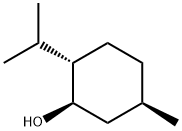
L-Menthol CAS #2216-51-5

Menthol, also known as hexahydrothymol, is commonly known as L-menthol, and its scientific name is 5-methyl-2-isopropyl-cyclohexanol. It is a very important cycloterpene alcohol. L-menthol has a characteristic mint aroma and has a cooling effect. Racemic ?C menthol also has a cooling effect, while other isomers have no cooling effect. L-menthol accounts for a large proportion of applications in medicine and health. It can be used as poultice, ointment, analgesic, local anesthetic, cooling agent, antipruritic agent, mouthwash, bactericide, and for the treatment of toothache, Tablets for stomach pain, neuralgia, etc.; the second largest use is spices. L-menthol is a spice in demand among cyclic monoterpene alcohols. It can be used as tobacco spices, used with peppermint oil to prepare toothpaste flavors, and other spices. Toilet water; menthol can also be used as a flavoring agent for a variety of foods, such as candies, chewing gum, cakes, fruit wine, refreshing drinks, etc.

L-Menthol CAS #2216-51-5
In Stock
FDA EU Reg. ISO 9001 HACCP Halal Kosher GMP

Technical Specifications

Product Name L-Menthol CAS #2216-51-5

Full COA, MSDS, FDA/EU compliance documentation and third-party lab reports available upon request.

Product Description

Menthol, also known as hexahydrothymol, is commonly known as L-menthol, and its scientific name is 5-methyl-2-isopropyl-cyclohexanol. It is a very important cycloterpene alcohol. L-menthol has a characteristic mint aroma and has a cooling effect. Racemic ?C menthol also has a cooling effect, while other isomers have no cooling effect. L-menthol accounts for a large proportion of applications in medicine and health. It can be used as poultice, ointment, analgesic, local anesthetic, cooling agent, antipruritic agent, mouthwash, bactericide, and for the treatment of toothache, Tablets for stomach pain, neuralgia, etc.; the second largest use is spices. L-menthol is a spice in demand among cyclic monoterpene alcohols. It can be used as tobacco spices, used with peppermint oil to prepare toothpaste flavors, and other spices. Toilet water; menthol can also be used as a flavoring agent for a variety of foods, such as candies, chewing gum, cakes, fruit wine, refreshing drinks, etc.

Description

L-Menthol CAS #2216-51-5

L-Menthol Basic information
Product Name: L-Menthol
Synonyms: (1R,2S,5R)-(-)-MENTHOL, 99+%, SUBLIMED;L-MENTHOL 99+% NATURAL FCC;L-MENTHOL, 99+%;(1R,2S,5R)-5-methyl-2-(1-methylethyl)cyclohexanol;Cyclohexanol, 5-methyl-2-(1-methylethyl)-, [1R-(1??,2,5??)]-;(1R,2S,5R)-(L)-Menthol;Mentol Crysta;L-MENTHOL, BP 99+%
CAS: 2216-51-5
MF: C10H20O
MW: 156.27
EINECS: 218-690-9
Product Categories: Inhibitors;Organics;chiral;Biochemistry;Terpenes;Terpenes (Others);for Resolution of Acids;Monocyclic Monoterpenes;Optical Resolution;Synthetic Organic Chemistry;API;2216-51-5
Mol File: 2216-51-5.mol
L-Menthol Structure
L-Menthol Chemical Properties
Melting point 41-45 ??C (lit.)
Boiling point 212 ??C (lit.)
alpha -51 o (589nm, c=10, EtOH)
density 0.89 g/mL at 25 ??C (lit.)
vapor pressure 0.8 mm Hg ( 20 ??C)
FEMA 2665 | MENTHOL RACEMIC
refractive index 1.46
Fp 200???F
storage temp. Store below +30??C.
solubility 490mg/l
form Crystals or Crystalline Needles
pka 15.30??0.60(Predicted)
Specific Gravity 0.89
color Colorless to white
Odor at 10.00 % in dipropylene glycol. peppermint cooling mentholic minty
Odor Type mentholic
optical activity [??]22/D 49??, c = 10 in 95% ethanol
Water Solubility insoluble
Merck 14,5837
BRN 1902293
Dielectric constant 3.2??Ambient??
Stability: Stable.
InChIKey NOOLISFMXDJSKH-KXUCPTDWSA-N
LogP 3.15 at 25??
CAS DataBase Reference 2216-51-5(CAS DataBase Reference)
NIST Chemistry Reference Cyclohexanol, 5-methyl-2-(1-methylethyl)-, [1R-(1?alpha?,2?beta?,5?alpha?)]-(2216-51-5)
EPA Substance Registry System Levomenthol (2216-51-5)
Related Products
Vitamin A Palmitate CAS# 79-81-2
Daily Chemicals

Vitamin A Palmitate CAS# 79-81-2

Vitamin A ester derivatives mainly refer to its alkyl acid esters, such as vitamin A acetate, vitamin A palmitate, etc. Due to the instability of vitamin A, commercial vitamin A is available in the form of its ester. However, vitamin A acetate easily absorbs water and gets damp, while vitamin A palmitate is more stable than vitamin A acetate. Vitamin A, commonly known as retinol, is an unsaturated monohydric alcohol with an ester ring. It is a yellow flaky crystal or crystalline powder. It is a fat-soluble vitamin. It is insoluble in water and glycerol, and soluble in alcohol, ether, hydrocarbon, Most organic solvents such as halogenated hydrocarbons. Retinol palmitate is an ester of retinol combined with palmitic acid, a saturated fatty acid that is the main component of palm oil. Retinyl palmitate is easily absorbed by the skin and then converted into retinol. It is a yellow or yellow-red solid or oily substance.

View Details →
Decyl glucoside CAS#68515-73-1
Daily Chemicals

Decyl glucoside CAS#68515-73-1

Decyl Glucoside is an eco-friendly, non-ionic surfactant derived from renewable resources. Renowned for its mildness and biodegradability, it is ideal for creating gentle, high-performing cleaning agents in personal care and household products. Its sustainable and effective nature makes it a preferred choice for green formulations.

View Details →
Hydroxytyrosol CAS#10597-60-1
Daily Chemicals

Hydroxytyrosol CAS#10597-60-1

Hydroxytyrosol, a potent antioxidant polyphenol derived from olives, is celebrated for its health-promoting properties. Highly valued in the nutraceutical, cosmetic, and pharmaceutical sectors, it contributes to the development of products that support well-being and skin health.

View Details →
Octocrylene CAS#6197-30-4
Daily Chemicals

Octocrylene CAS#6197-30-4

Octocrylene is an organic compound widely recognized for its potent UV-filtering properties, making it an essential ingredient in sunscreens and other skincare products designed to protect the skin from harmful ultraviolet radiation. With the chemical name 2-(4-Methylbenzyl)-2H-benzotriazole-5-methyl, octocrylene is a stable and photostable molecule that provides broad-spectrum protection against both UVA and UVB rays. This oil-soluble chemical is valued for its ability to absorb UV radiation effectively, converting it into heat without causing skin irritation or staining clothes. Octocrylene is often used in combination with other UV filters to enhance the sun protection factor (SPF) of formulations, ensuring a balanced and comprehensive defense against sun damage. As a lipophilic compound, octocrylene is compatible with various cosmetic and dermatological formulations, contributing to the development of lightweight, non-greasy sunscreens. Its chemical structure allows for a high degree of safety and efficacy, making it suitable for a wide range of skin types, including sensitive skin. In summary, octocrylene is a reliable and efficient UV filter, pivotal in the formulation of modern sunscreens that offer advanced protection against the sun's harmful effects while maintaining skin comfort and product aesthetics.

View Details →
Ready to Order?

Get Free Samples & Full
Certification Package Today

No minimum order for samples. COA, MSDS, FDA/EU certificates and third-party lab reports delivered with every sample. Technical team responds within 24 hours.