Polyglutamic Acid CAS# 25513-46-6

Polyglutamic acid (y-PGA), also known as natto gum, is a high molecular peptide polymer synthesized from several glutamic acid monomers through microbial fermentation. It is rich in glutamic acid, glucose, protein and minerals. , vitamins and other biologically active substances. Polyglutamic acid (??-PGA) is a sticky substance that was first discovered in ??Natto??. It is currently widely used in agricultural production and is called a new biostimulant. It is fully water-soluble, biodegradable, edible, and non-toxic. It is a biopolymer produced by microbial fermentation.

Polyglutamic Acid CAS# 25513-46-6
In Stock
FDA EU Reg. ISO 9001 HACCP Halal Kosher GMP

Technical Specifications

Product Name Polyglutamic Acid CAS# 25513-46-6

Full COA, MSDS, FDA/EU compliance documentation and third-party lab reports available upon request.

Product Description

Polyglutamic acid (y-PGA), also known as natto gum, is a high molecular peptide polymer synthesized from several glutamic acid monomers through microbial fermentation. It is rich in glutamic acid, glucose, protein and minerals. , vitamins and other biologically active substances.

Polyglutamic acid (??-PGA) is a sticky substance that was first discovered in ??Natto??. It is currently widely used in agricultural production and is called a new biostimulant. It is fully water-soluble, biodegradable, edible, and non-toxic. It is a biopolymer produced by microbial fermentation.

Description

Polyglutamic Acid CAS# 25513-46-6

Polyglutamic acid Basic information
Product Name: Polyglutamic acid
Synonyms: POLY-L-GLUTAMIC ACID 15’000-50’000 SODIUM SALT;POLY-L-GLUTAMIC ACID 2’000-15’000;POLY-L-GLUTAMIC ACID 50’000-100’000 SODIUM SALT;L-GLU-(L-GLU)N-L-GLU;glutamicacidpolymer;POLY-L;gamma-poly(L-glutamic acid) macromolecule;G-poly glutamic acid
CAS: 25513-46-6
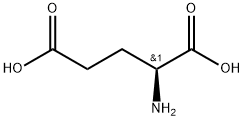
MF: C5H9NO4
MW: 147.13
EINECS: 200-293-7
Product Categories: Amino Acids;Homopolymers;Polyamino Acids;25513-46-6
Mol File: 25513-46-6.mol
Polyglutamic acid Structure
Polyglutamic acid Chemical Properties
storage temp. ?20??C
InChI InChI=1/C5H9NO4/c6-3(5(9)10)1-2-4(7)8/h3H,1-2,6H2,(H,7,8)(H,9,10)/t3-/s3
InChIKey WHUUTDBJXJRKMK-ZJPLZJKBNA-N
SMILES [C@@H](N)(C(=O)O)CCC(=O)O |&1:0,r|
Safety Information
WGK Germany 3
RTECS MA1700000
F 3-10
Related Products
Sodium Isethionate CAS#1562-00-1
Daily Chemicals

Sodium Isethionate CAS#1562-00-1

Sodium 2-hydroxyethyl sulfonate (also known as sodium hydroxyethyl sulfonate) is a sodium salt of 2-hydroxyethanesulfonic acid (hydroxyethyl sulfonate), which is used as a hydrophilic head group in detergent active surfactants. Due to its strong polarity and resistance to multivalent ions, it is called hydroxyethyl sulfonate (acyloxyethanesulfonate). It is being studied as a high-yield chemical in the High Production (HPV) Chemical Challenge Program of the US Environmental Protection Agency (EPA). Solid sodium 2-hydroxyethyl sulfonate is a colorless, free flowing, non hygroscopic solid that is easily soluble in water and has good biodegradability. Due to the synthesis method, the sample usually contains trace amounts of sodium sulfite or sodium bisulfite, resulting in a pH value of about 10 in the aqueous solution, which is weakly alkaline.

View Details →
Ectoine CAS#96702-03-3
Daily Chemicals

Ectoine CAS#96702-03-3

Ectoine is a naturally occurring osmoprotectant, a cyclic amino acid derivative that offers exceptional cell-stabilizing properties. Highly valued in cosmetics and pharmaceuticals, it enhances product efficacy by maintaining cell integrity under various environmental stresses.

View Details →
Idebenone CAS 58186-27-9
Daily Chemicals

Idebenone CAS 58186-27-9

Idebenone is an organic compound with the chemical name: 6-(10-hydroxydecyl)-2,3-dimethoxy-5-methyl-1,4-benzoquinone. It is a structural analogue of coenzyme Q10 and is developed by Takeda Pharmaceuticals as a drug for the treatment of cognitive diseases such as Alzheimer??s disease. Idebenone has an activating effect on mitochondrial function, improves brain metabolism and brain dysfunction, and can increase the utilization rate of glucose in the brain and promote the generation of ATP; it improves the metabolism of the neurotransmitter 5-hydroxytryptamine in the brain and has a strong antioxidant and free radical scavenging effect. In clinical practice, it is mainly used to treat many central nervous system degenerative diseases related to oxidative stress, such as Parkinson??s disease, Alzheimer??s disease, multi-infarct dementia, local cerebral anemia and brain failure, etc. It is also used to treat Friedreich??s ataxia. It can also be used in cosmetic formulas, with cosmetic efficacy such as scavenging free radicals, inhibiting lipid peroxidation, inhibiting inflammation, inhibiting DNA damage, light protection, and reducing pigmentation.

View Details →
Ethylhexyl Palmitate CAS#29806-73-3
Daily Chemicals

Ethylhexyl Palmitate CAS#29806-73-3

Ethylhexyl Palmitate is a skin-conditioning ester, derived from ethylhexanol and palmitic acid, that imparts moisturization and a smooth texture to cosmetic and personal care formulations. It is valued for its emollient properties, enhancing the sensory experience of skin care products.

View Details →
Ready to Order?

Get Free Samples & Full
Certification Package Today

No minimum order for samples. COA, MSDS, FDA/EU certificates and third-party lab reports delivered with every sample. Technical team responds within 24 hours.